Toward a Dimensional Classification of Neurodevelopmental and Psychiatric Conditions Using Imaging and Genetics#
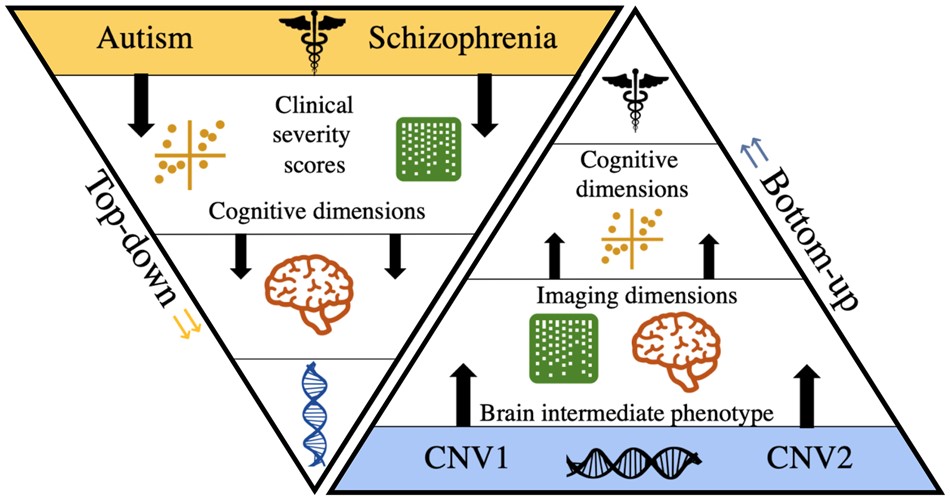
Source: Moreau et al., (2021). Brain. https://doi.org/10.1093/brain/awab096
Psychiatric research has traditionally relied on a top-down approach - comparing clinically defined diagnostic groups to controls - to identify biomarkers. However, this strategy has often produced inconsistent and non-replicable findings, largely due to the substantial heterogeneity within diagnostic categories. In clinical practice, comorbidities are the norm (e.g., ADHD frequently co-occurs with autism spectrum disorder), and clinical profiles vary widely. These challenges likely reflect the complex genetic architecture of psychiatric disorders, including pleiotropy (shared genetic variants across conditions) and polygenicity (many variants contributing to a single disorder). These observations underscore the need to rethink psychiatric nosology by shifting toward biologically grounded, dimensional approaches rather than categorical symptom-based classifications.
Our lab adopts a bottom-up approach, starting from genetic variants associated with psychiatric conditions to investigate their impact on brain-based endophenotypes. The goal is to identify biologically meaningful dimensions that transcend traditional diagnostic boundaries. This strategy has already revealed shared functional brain alterations across psychiatric disorders—for example, thalamo-sensorimotor hyperconnectivity observed in autism, schizophrenia, and obsessive-compulsive disorder. We are currently extending this work to examine how genetic risk variants shape early brain development (e.g., in infants) and how polygenic scores influence multimodal neuroimaging and EEG features in children.
In parallel, we also adopt a top-down, large-scale transdiagnostic perspective through international initiatives such as ENIGMA, particularly in functional neuroimaging studies aimed at identifying brain-based dimensions that cut across psychiatric and neurodevelopmental conditions.